Türkiye’de Enflasyonun Makroekonomik Analizi ve Modellemesi
Macroeconomic analysis and modelling of inflation in Türkiye.
Read on Medium →Data Scientist · Credit Risk Analytics Leader · Independent Advisor
I apply data science and machine learning to credit risk, leading analytics across the credit lifecycle that turn complex data, models and portfolio signals into better decisions.
Areas of Expertise
Five connected disciplines that span the credit risk lifecycle, from modelling and econometrics through to executive decision-making.
Selected Work
Analytical work spanning the credit lifecycle. Organisational identifiers are generalised throughout.
Certain details and organisational identifiers have been generalised to protect confidentiality.
Certain details and organisational identifiers have been generalised to protect confidentiality.
Certain details and organisational identifiers have been generalised to protect confidentiality.
Certain details and organisational identifiers have been generalised to protect confidentiality.
Certain details and organisational identifiers have been generalised to protect confidentiality.
Experience
A career built around turning credit risk data into decisions — from origination analytics through to collections and legal recovery.
As Credit Analytics Group Manager at Enparabank, I own the end-to-end analytics, reporting and data infrastructure of all credit products — preparing and presenting monthly risk reports to the Credit Risk Committee and senior management, building predictive machine-learning models to support management decisions, and developing automation that saves operations teams significant time and effort.
Acıbadem Healthcare Group
Enparabank
Tarfin
Denizbank
Enparabank
About
I work across the credit lifecycle — from origination and portfolio monitoring through to delinquency, collections and NPL — connecting modelling, data architecture and executive reporting into a single, coherent view of risk.
Models and dashboards are only as useful as the structure behind them. I favour understanding the mechanism behind a portfolio movement — the causal and structural drivers — before treating a number as a signal to act on.
History, sociology, philosophy and statistics inform how I approach analytical problems — as ways of thinking about structure, causality and human behaviour, not as separate hobbies from the analytical work itself.
SQL, Python, R, SAS, SPSS, Stata, Eviews and Power BI — used as means to solve credit risk and business problems, not as the value proposition itself.

Writing & Research
50+ articles on Medium covering statistics, philosophy and data science, alongside academic and book publications. A selection below.
Macroeconomic analysis and modelling of inflation in Türkiye.
Read on Medium →Macroeconomics versus NPL stock: a time series analysis.
Read on Medium →NPL dynamics in Turkish banking and their relationship with macroeconomic indicators.
Read on Medium →Paradox and data.
Read on Medium →On falsifiable thinking.
Read on Medium →
Working Notes
Technical notes written to be handed to someone else: single-image explainers for LinkedIn, and long-form A4 guides on the models I work with day to day.
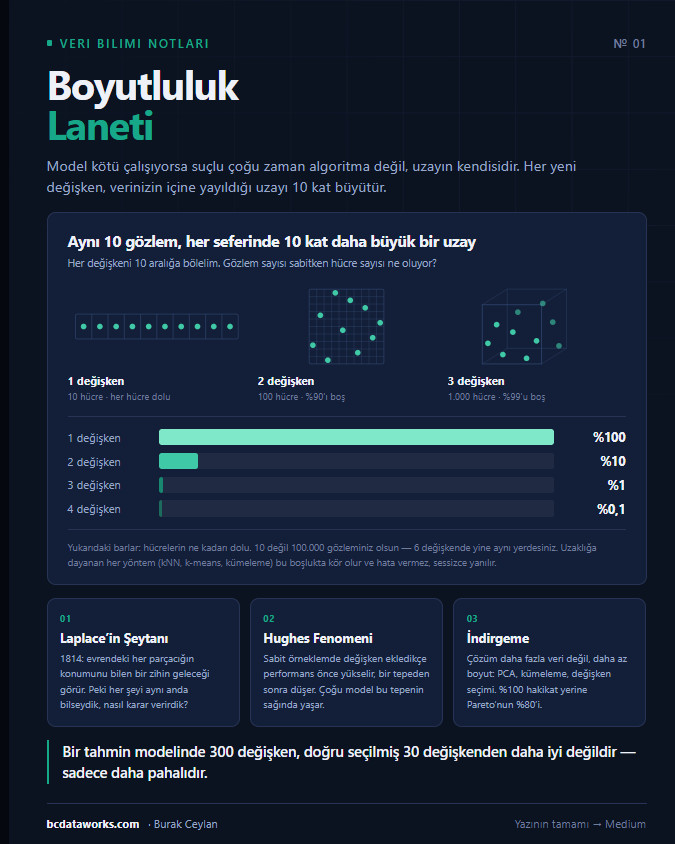
The curse of dimensionality — every added variable multiplies the space your data spreads into by ten, while the data itself stays the same. In Turkish.
Open the explainer →Why a separate format. A long article proves the thinking. A single image proves it can be handed to a risk committee without a reading assignment — usually the harder half.
Every explainer follows the same skeleton: hook, evidence, three ideas, one takeaway. The chart rules are deliberately strict — a single series, linear bar lengths, methodology always stated.
New notes are added as the underlying articles are published.
From the perceptron to the MLP: not just the formulas, but what the model learns and why. Backpropagation, a credit risk application and Python examples. In Turkish.
№ 02 · Gradient boosting practice guideNot what each parameter does but how they interact, read as a symptom–action chain. Includes starting ranges for credit risk and a step-by-step tuning strategy. In Turkish.
№ 03 · Gradient boosting librariesAll three do the same job; the difference lives in three design decisions. Those decisions visualised, the parameters mapped across libraries, and a comparison on credit risk data. In Turkish.
№ 04 · Tree ensemblesBoth are tree ensembles splitting the same way. One decision separates them — are the trees independent, or built on each other's errors — and it changes everything downstream. In Turkish.
№ 05 · Credit cards · early riskTechnically a subset of default, in practice a separate problem: the decision forms before any behavioural data exists, and part of the event is not credit risk at all. In Turkish.
№ 06 · Sequential data modelsA cell built on one idea: open a separate channel to carry information, and let small gates decide what enters it and what stays. What the gates do, how to shape the data, and where LSTM actually pays off in banking. In Turkish.
I work with financial institutions and analytics teams on credit risk modelling, portfolio analytics, decision systems and analytics transformation.
Contact
Share a brief outline of the problem you are facing. All conversations are treated confidentially, and no sensitive customer or portfolio data should be included in this form.